

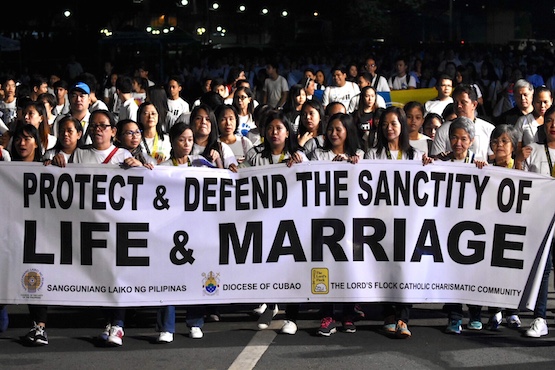
Our Catholic Faith only defines marriage as “indissoluble union of one man and one woman contracted in a sacrament of matrimony.” Since the ancient times, Christianity have it rightly defined, that Holy Marriage as it explains, brings the most joy and blessing to humanity. More so, the Philippine Constitution recognizes marriage as a social institution, a foundation of the family, and therefore, inviolable.
Divorce, on the other hand, destroys family by terminating the marriage and abusively using irreparably broken relationships as the main reason why our country needs it.
Divorce threatens our society by making the families broken and affects the growth of children who did not experience the love of being in a family which could also put their future in danger. And also affecting the society by destroying the unity in the community and breaking apart the basic unit of the society which is the FAMILY.
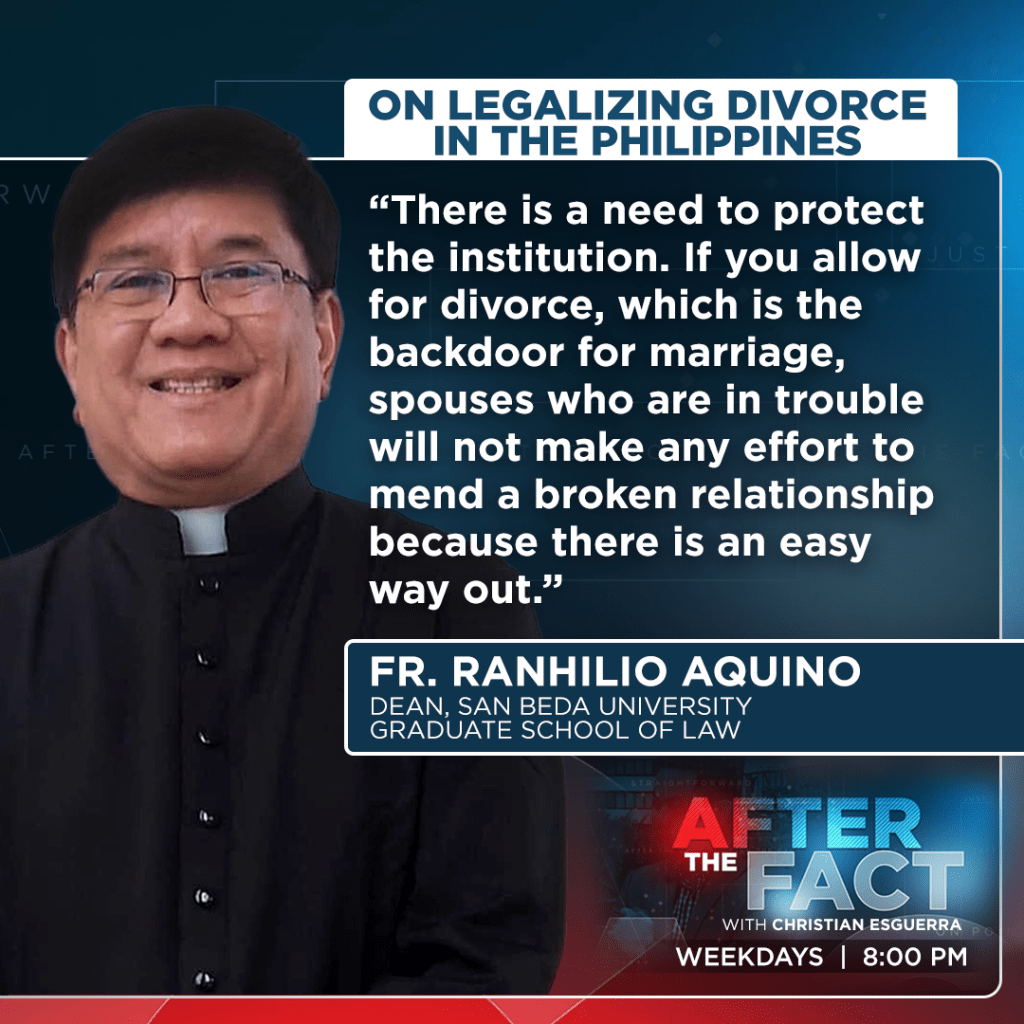
And we wish to explain why these are all lies… and how a couple can avoid these so-called “failed marriage”
For so many years, many of our legislators attempted to pass a bill legalizing divorce in the Philippines. Fortunately, none of the versions have been enacted into law.
Let us begin by revisiting Catechism of the Catholic Church paragraph 1601 which tells us that “Marriage is a lifelong partnership of the whole of life, of mutual and exclusive fidelity, established by mutual consent between one man and one woman, and ordered towards the good of the spouses and the procreation and education of offspring.”
It is a packed full of elements. A self-explanatory statement – each deserving of its own deeper explanation and reflection which will makes us understand the richness of marriage.
The First Element – MARRIAGE IS A LIFELONG PARTNERSHIP
This element springs from the promise that Christ made to us that he would never leave us. In marriage, permanency allows each spouse to reveal all that they are and all that they are not to the other – if you will the good, the bad and the ugly. Without permanency, each spouse may be constantly concerned that who they are may not be good enough. Without the element of permanence, the temptation would be great to “do” for the other rather than “be” with the other. With permanency, the spouses have permission to “be” for each other – to become a total gift of self. And it is through the giving of one self that one finds oneself. (Gaudiem et Spes #24)
The Second Element – MARRIAGE IS TO BE MUTUALLY EXCLUSIVE
The reality of this element is that marriage places limits upon the couple, specifically sexual limits. Living in the married state requires discipline of the sexual desire. Placing limits on the sexual expressions within marriage retains the goodness of sexual intimacy as designed by God. It is only within marriage that sexual activity can contribute to both the good of the spouses and to the common good of society. I must add here that the proper sexual expression of one’s sexuality is not a given within marriage. Spouses must work to master their sexual love so that it becomes more than just a body needing another body. They must strive to unite as persons – body and soul. Just as sexual discipline is needed before marriage – e.g. though abstinence, – sexual discipline is also needed within marriage.
Most people can see the rationale for mutual sexual exclusivity – especially in this day and age where the scourges of sexual freedom are very apparent; unwanted children, sexual diseases, crimes of sexual desire, etc. It is truly sad that the current culture has traded sexual intimacy (tenderness, understanding, closeness, affection) for sexual intensity (passion, power, force, self-absorption).
The last element is – MARRIAGE IS A MUTUAL CONSENT
This means that spouses are to enter into marriage freely. The decision to marry must be one’s own so that there is personal buy in and commitment to the promises of the Sacrament.
What are these promises?
1. To love only one man and woman – this element of Christian marriage recognizes and values the Creator’s decision to design human persons in two physical forms – male and female – with equal dignity. The embodied differences give rise to human persons being able to pro-create new life and to enjoy a unity of persons that is described as the “one flesh union.” In God’s design, marriage is meant for one man and one woman.
2. Good of the spouses is another element of marriage and it highlights the creator’s desire that spouses should become a better persons though marriage.
This part of the definition of marriage recalls the bible passage, “it is not good for man to be alone. I will make a suitable partner for him.” (Gn 2:18) This has come to be known as each spouse’s need to be a helpmate to the other. It is the understanding that spouses are meant to be in relationship and that each person – though filled with many gifts and talents – does not have all the possible gifts and talents available from God. By being helpmates, spouses can complement each other and provide what may be lacking in the other.
3. Procreation and education of offspring is the final element of marriage and it provides the basis for family life. Marriage is meant to attach children to their parents and parents to their children. It is meant to be the foundation of society and the Church because, as Blessed John Paul II tells us, the future of humanity passes by way of the family. (Familiaris Consortio #86)
If only our parents and many young couples todays, truly understand and lived by the meaning and importance of marriage — THERE WILL BE NO BROKEN RELATIONSHIPS.
There are 2 simple things being asked to us as CHRISTIANS.
1. Pray for your partner. Before contracting a marriage, make sure that you ask God for a good partner. Praying for a partner does not end when you found him/her. Prayer is always a good companion in marriage even after the ceremony. You have to pray together. Putting God at the center of the relationship is a must!
2. SEX is a Sacred Exchange between married couple. Respect the purity of heart and body. Do not engage into pre-marital sex.
What to do when you are in an abusive relationship?
Simple answer would always be: Report to the proper authorities. Divorce is not the immediate solution. When someone (even your partner) is threatening you, your life and your children, do not be silent, report to the authorities.
We know ANNULMENT IS WAY BETTER than divorce, but annulment is too expensive. What can we do?
If your partner happened to fall into the following ground for annulment: lack of parental consent (for those who are minors, and 18-21 years old), unsound mind, fraud, force intimidation or undue influence, physical incapacity, sexually transmissible diseases, psychological incapacity and those accepted by the Catholic Church, you file for annulment.
Annulment unlike divorce, nullifies marriage as if it never happens. While divorce marks too much hurt not only to the couple but to their family.
However, there are so many misconceptions on annulment in which I will discuss in the next article. But here’s a sure thing: ALL CASES IN THE PHILIPPINE COURTS ARE EXPENSIVE BECAUSE IT HAS BECOME A BUSINESS. In due time, divorce cases will be more expensive. In the US alone, the minimum time spent in hearing a divorce case is 6 months, imagine the expenses it will occur especially in the economic status of the Philippines today.
The bottom line is we need to make-up our minds and start to think deeply with God, and constantly ask him to give us a healthy relationship.
REMEMBER, to marry is a vocation.
Source: https://catholiclife.diolc.org/2018/10/25/marriage-why-the-catholic-church-has-the-right-definition/
 Young Faith in Action Movement
Leave a comment